

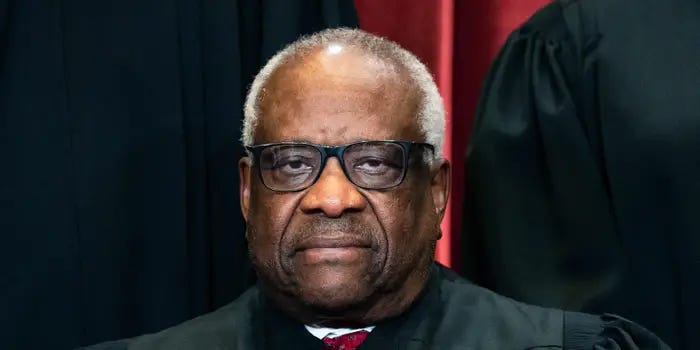
In a recent speech, Clarence Thomas returned to a familiar but foundational claim. Drawing on his experience in the segregated South, he invoked the Declaration of Independence—its assertion that all are created equal and endowed with unalienable rights—not as abstraction, but as lived truth. Rights, in this telling, do not come from government. They precede it. They are grounded in nature, or in God, and it is the task of law to recognize, not create them.
It is a powerful idea. It has sustained people through injustice and given language to movements that sought to overcome it. And yet, its power is not uncomplicated.
If rights are inherent—self-evident and universal—one is left to ask why they required such prolonged struggle to be acknowledged. Slavery persisted under the same Declaration that proclaimed equality. Segregation endured under a Constitution that spoke of liberty. The principle did not enforce itself. That is not a theoretical problem. It is a historical one.
Which raises a more difficult question: who determines what those natural rights require?
Appeals to nature or to God do not resolve the issue. They relocate it. History offers no shortage of competing claims made in their name—slavery defended as ordained, and later condemned as a moral abomination. The principle remained; its meaning was contested. Nature and God do not speak for themselves. People speak for them.
This tension is not confined to any one school of thought. It appears wherever principles are invoked as fixed, even as their meaning remains subject to interpretation. Justice Thomas himself has framed the issue in similar terms, describing progressivism as a fundamental threat to the constitutional order. Such claims are themselves acts of interpretation, not conclusions that arise independently of judgment. They illustrate how appeals to fixed principle continue to depend on contested readings of what those principles require.
In practice, it has been institutions—courts, legislatures, and citizens acting through them—that have given content to these claims. The expansion of rights in American life has not occurred in the absence of government, but often through it. One can believe that rights are inherent and still recognize that their realization depends on human judgment.
It is here that the role of a judge becomes particularly interesting. The Court is charged with interpreting the Constitution—a document of law. But when the argument turns to principles said to exist beyond law, the task becomes less straightforward. If those principles must be interpreted, then whose interpretation governs? At that point, the distance between applying law and asserting judgment begins to narrow.
To invoke natural law is to claim the authority of fixed principle. But such a claim carries an obligation: that those principles meaningfully constrain not only how one reasons, but how one acts.
None of this diminishes the importance of the Declaration. But it may suggest a different way of understanding it—not as a settled description of reality, but as a statement of ambition. It did not so much describe America as declare what America might one day become. Its language was persuasive, even aspirational—advanced in a moment that required unity and justification—and far ahead of the society that produced it.
That distance between principle and practice has never fully disappeared.
The tension is not confined to theory. Arguments for limited government, often grounded in these same principles, have in practice coexisted with the regular exercise of state power—sometimes expansive, sometimes selective. This is less a contradiction than a condition: governing rarely conforms neatly to the philosophies that justify it.
Which brings us back to the central claim.
The Declaration provides a language of moral clarity. But it does not eliminate the need for interpretation, nor does it substitute for the institutions through which those interpretations are made real. Its principles have mattered—deeply—but they have mattered most when individuals and institutions have compelled the country to take them seriously.
Left alone, they have shown a capacity to coexist with injustice.
The achievement of American life has not been the discovery of those principles, but the discipline of insisting that they mean something.
And that discipline, whatever its source, remains unmistakably—and unavoidably—human.