

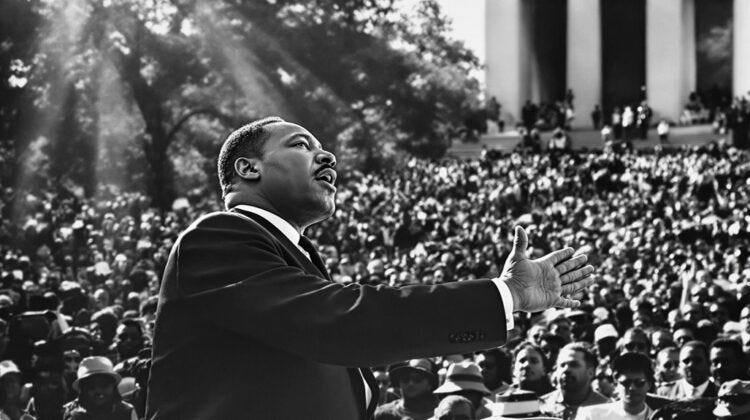
I’ve always been uneasy when the “wrong” invokes the name of Martin Luther King, Jr. Still, I suppose I should be grateful. We have a holiday. He is remembered well enough to be cited at all. That matters—especially at a moment when the Trump Administration has suggested the civil rights movement was somehow harmful to white Americans, while simultaneously working to undermine both the teaching and public understanding of Black history.
I was in high school during the years when civil rights groups nearly had to fight for the holiday itself as fiercely as King had fought for justice. Even after Congress acted in 1983, it took 17 more years before all 50 states recognized it. My home state of Virginia managed a particular contortion: neutralizing King’s legacy by folding Robert E. Lee and Stonewall Jackson into the same observance. It was recognition in name, resistance in spirit.
Many conservatives who now invoke King’s words for convenience were politically opposed to the holiday in the first place. More importantly, the same line of political thought fought King every step of the way while he was alive—opposing each march, each speech, each attempt to force the country to reckon with itself. They sanctioned surveillance, branded him a communist and a rabble-rouser, and treated his insistence on justice as disorder. To summon him now as an avatar of calm and consensus misses the point. He is invoked not to be followed, but to be contrasted—an acceptable figure from the past, used to make today’s moral claims seem excessive, impatient, or suspect.
Nonviolence is often presented as King’s defining feature, as though it were merely temperament. In truth, it was also strategy. As a minister and a father, nonviolence may have come naturally to him—but as a tactician, he understood its power. It exposed the moral rot of segregation by forcing its defenders into the open, revealing violence and intolerance where they claimed order. King was not only a preacher of conscience; he was a revolutionary in his use of media, a careful navigator of political terrain both North and South, and a relentless advocate who refused to limit his concern to racial injustice alone. Any injustice that degraded human dignity was, to him, part of the same moral failure.
One wonders where today’s MAGA movement—and even many conventional conservatives—would place King if he were alive now. It is hard to believe he would be embraced rather than treated as many Black political figures are today: denounced, caricatured, and cast as dangerous the moment moral clarity becomes inconvenient.
Should I be pleased that his name is still invoked, even selectively, so that the man and the cause remain visible? Perhaps on his birthday, that is the wiser posture. Let him be celebrated on Monday. There will be time on Tuesday to resume the harder work—remembering not just what King said, but why he said it, and why so many fought him for saying it at all.