

If I were Donald Trump, and it had become apparent that the swagger was fading— that the House was likely to flip next November and the Senate was no longer safely out of reach—I would recognize a simple truth: the thrill is gone.
Telling Americans that everything is wonderful, and that whatever is not is Biden’s fault, no longer suffices. The markets may be buoyant, but households feel the pressure. Masked federal agents in American cities are unsettling, not reassuring. Talk of war with Venezuela alarms even the indifferent. The quiet accommodation of Russia’s territorial ambitions has left allies uneasy. And Project 2025—whether completed or merely well underway—has already delivered much of what its architects wanted.
At that point, I would do what Trump does best: declare victory.
The trade war has been “won.” Undocumented immigration has been “stopped.” The administrative state has been hollowed out. Corporate and academic America have been “disciplined.” Enough. Mission accomplished. Lower the curtain.
Lift the tariffs—all of them. Send the federal agents home and let them remove their masks. Return the National Guard to their barracks, preferably in time for Christmas. Announce satisfaction with Europe’s progress on defense spending. In short, perform a sudden conversion to reasonableness.
The effects would be immediate. Markets, already elevated, would soar. Without tariffs, inflation would ease, giving the Federal Reserve room to cut rates further. Real estate would revive. 2026 could be framed as a banner year—provided Americans have had sufficient wine to forget the turbulence of 2025.
And Trump himself? He has already had the most successful financial year of his life. The ballroom rises. His name adorns the Kennedy Center. He has delivered, at least symbolically, a restoration of pride to those who felt dispossessed. By declaring victory on all fronts, he could consolidate his gains and gamble—again—on the shortness of public memory. It has worked before.
But history offers another path, and it is the darker one. Steve Bannon has said plainly that losing power means prison. That is how movements convince themselves that retreat is impossible.
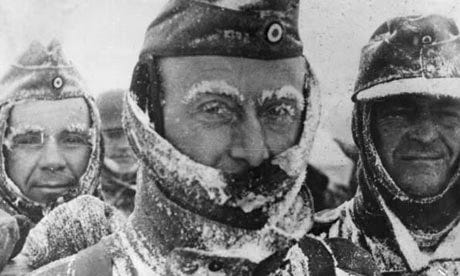
In 1941, Germany stood at a similar juncture: triumphant beyond expectation, dominant in Europe, its project vastly more successful than anyone in 1933 could have imagined. Operation Barbarossa was not born of strength, but of impatience—of the belief that one more push would secure permanence. History, as we know, had other plans.
The question now is whether Trump chooses consolidation—or escalation.