

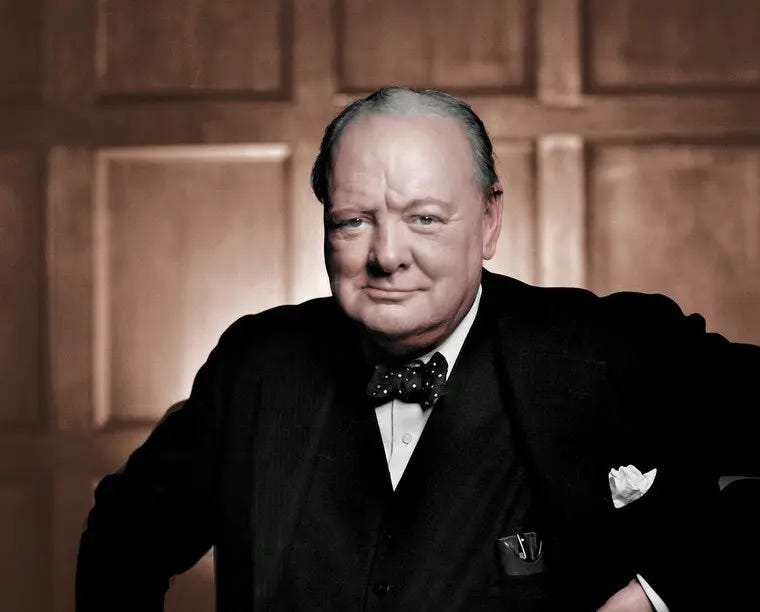
In June 1940, as France was collapsing under the German advance, Winston Churchill flew to France for desperate meetings with French leaders. At lunch in Tours, French refugees gathered outside the restaurant and stared through the windows at the British prime minister. Churchill was unperturbed. Let them stare, he said in effect. It was good for them to see the Prime Minister of Great Britain calmly eating his lunch.
Even then — before he became the figure we think of today — Churchill understood the power of the image. He was acutely conscious of history and of his prospective place in it.
There is nothing necessarily wrong with that.
People enter politics for many reasons. Some genuinely believe they can improve the lives of others — a conviction requiring confidence and, at its best, a sense of obligation. Others seek money, influence, or power. And some enter politics with history already looking over their shoulder.
When the Clintons ran, they saw themselves as historical figures. “History is made by the first-timers,” Susan Stanton once said — a line Joe Klein attributed to Hillary Clinton. There is something noble in knowing history and wanting to shape it, to be remembered as someone who mattered. Churchill certainly felt that impulse. So did de Gaulle and Johnson. Political ambition and historical ambition have often traveled together.
Churchill also understood self-promotion. The cigar, the V-sign, the bulldog persona — none of it was entirely accidental. He understood theater and knew that leadership sometimes required it. The French people staring through that restaurant window in 1940 weren’t merely watching a man eat lunch. Churchill wanted them to see a British prime minister who remained calm while France collapsed around him.
But the image ultimately had to be attached to conduct.
Donald Trump has his own version of historical ambition. He wants monuments bearing his name, his likeness on government documents and currency, and to be remembered as the greatest president. Or perhaps he simply wants to remain in office longer. The distinction is not always clear.
But history is not a sales job.
Trump has twice convinced voters to elect him president, and he has unquestionably changed Washington, the United States, and the world through decisive action. His historical significance is already assured. The judgment of that significance is another matter.
Eventually, he will not be able to spray-tan, adjust his hair, straighten his long red tie, and explain to posterity why he was so great. The rallies will end. The speeches will stop. The branding will remain for a while, but the salesman will no longer be there to sell it.
That is the peculiar thing about historical ambition. A politician can influence the record. He can write memoirs, commission portraits, name buildings, cultivate admirers, and even construct monuments to himself. Churchill did some of this in his own way; his enormous literary output helped shape how generations understood both him and the war.
But eventually the politician loses control.
History is stubborn. It can be influenced, distorted, even mythologized, but it cannot be permanently managed. Eventually the speeches end, the portraits are hung, and the politician is no longer around to explain himself.
What remains is what happened.
Churchill understood the photograph.
History eventually asks what happened after the photograph was taken.