

Soccer is a strange game. You spend ninety minutes interpreting patterns, only to leave wondering whether the score truly reflected the match you watched. Sometimes it does. Sometimes it merely reflects which team better understood the decisive stretches.
Marshall traveled up Leesburg Pike to face defending state champion Herndon with plenty still at stake: second-place implications in the brutal Liberty District, momentum heading into the postseason, and perhaps validation that Tuesday’s overtime loss to top-ranked Washington-Liberty had reflected their rise more than their disappointment.
This is the point in the high school season when the sport becomes most compelling. By May, teams have spent more than two months together, and the rhythm begins to resemble high-level club soccer. But high school retains elements club can never quite replicate: uneven field dimensions, freshmen sharing the field with seniors, varying tactical sophistication, and the emotional volatility that comes from playing for a school rather than a badge assembled by age group. Club commitments begin to ease, attention narrows, and the intensity rises.
Marshall arrived with serious attacking quality. Amen Kumelachw and Imad El-Yagouti are Division I-bound players, while Drew Clague and Carter Thomas provide width and directness. The Statesmen have talent throughout the pitch and enough attacking firepower to trouble anyone in the region. And this year, something else changed: Marshall’s top club players committed fully to high school soccer, transforming a program long associated with the bottom of the Liberty into one of the season’s most compelling stories.
But Herndon may be the most complete side in the state.
Their back line, marshaled by Division I commit Brennan Mara, defends aggressively without losing structure. The midfield combines technical quality with relentless work rate. And ahead of them is future George Mason University player Manny Mequainint, whose final varsity season has become one of the defining individual runs in Northern Virginia soccer over the past two years. This is also a team forged by pressure — Herndon won last year’s state championship while surviving two penalty shootouts. They know how to manage tense moments together.
Yet the opening stages were tense rather than fluid. Herndon generated danger but lacked precision in the final third, occasionally misplacing passes they normally complete comfortably. Marshall, meanwhile, needed time to settle into the match but gradually began finding spaces behind Herndon’s midfield pressure.
In fact, the Statesmen produced the game’s first major chance when a set piece ricocheted dangerously through the area, forcing goalkeeper Zen Patton into a sharp reaction save. Patton would make another important stop moments later, preserving the uneasy balance of the opening half.
Then came the first real inflection point.
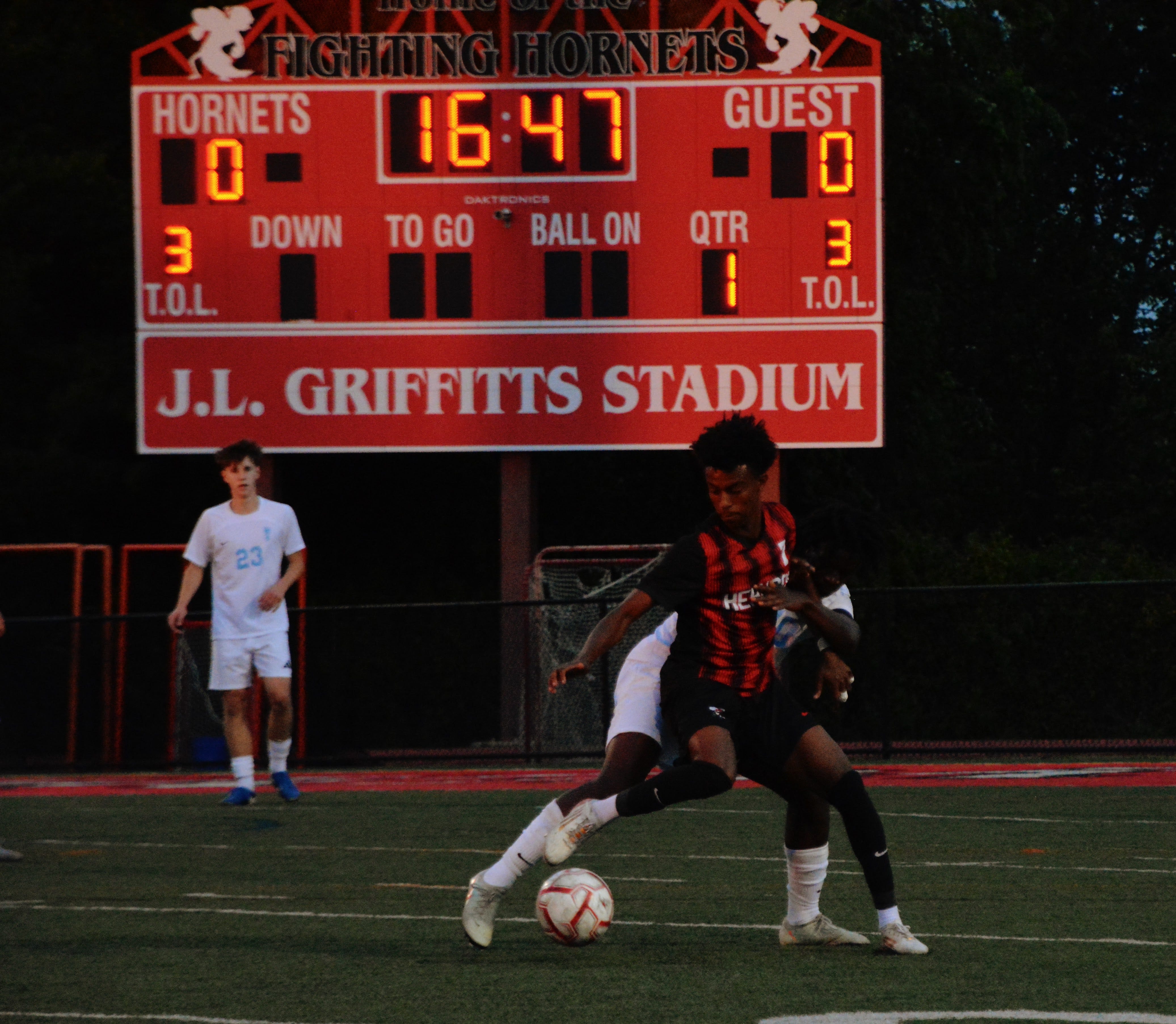
Mara stepped forward and found Mequainint with a perfectly weighted ball into space. The timing of the run mattered as much as the acceleration that followed. Mequainint separated effortlessly, accepted the pass in stride, and finished calmly for 1–0.
What followed revealed something important about both teams.
Marshall briefly became emotional — players gesturing toward one another, looking for fouls, trying to generate momentum through direct kicks and urgency. Herndon did the opposite. The Hornets simplified. Their pressing tightened, Angel Romero and the midfield shielded the back four more compactly, and possession became less ambitious but more controlled. It was striking to watch a defending champion collectively recognize the moment and settle the match.
Marshall still remained dangerous. The Statesmen defended resiliently through the remainder of the half and entered the second period very much alive in the match.
But eight minutes after halftime came the second turning point.
Shalom Assogba collected the ball wide on the right and began a run that seemed repeatedly on the verge of collapsing. His touches seemed too loose, too improbable to survive the traffic — yet somehow they kept carrying him forward as defenders failed to fully dispossess him. Suddenly he emerged in front of goal and drove a fierce finish across the keeper.
At 2–0, the game opened.
Marshall continued to attack and eventually found a response when holding midfielder Perry Wooten advanced into the play and scored via a deflected strike — the sort of deflection it took to finally beat Patton.
For a brief spell, the Statesmen threatened to make the game unstable.
Instead, Herndon accelerated again.
Patton produced two outstanding saves to extinguish Marshall’s momentum before a poor clearance fell to Jerald Guevara, who volleyed low into the near corner for 3–1. Mequainint later added another after a winding run that mirrored Assogba’s earlier goal, and the match eventually closed at 5–1 — a scoreline that felt simultaneously deserved and slightly misleading.
Because for moments, Marshall’s attacking talent is explosive.
But championships often reveal themselves less through constant domination than through collective control of decisive phases. Herndon defended with extraordinary concentration after taking the lead, compressed space intelligently in midfield, and punished transitions ruthlessly once the match loosened.
That is what impressed most leaving the stadium — not simply the goals, though several were beautiful, nor Patton’s excellent goalkeeping, though it preserved the game’s shape early. It was Herndon’s collective understanding of pressure and tempo. They looked like a team comfortable carrying expectation.
Wow! Another top-notch piece by you. Will share this with Dev. Thank you Julian!