

Friday night brought a long-awaited rematch of last year’s state final: Herndon against Wakefield. Ten months earlier, both sides had survived extraordinary semifinal escapes—each advancing through penalty shootouts—to meet in Richmond, where Herndon prevailed 2–0.
That scoreline, like many finals, understated the journeys that preceded it. Wakefield’s 2025 run was among the more remarkable in recent Northern Virginia play: three major upsets of top-ranked opponents, multiple comebacks from two goals down, and a team that seemed to grow more composed the closer it came to elimination. Herndon, steadier but no less impressive, proved a worthy champion—deep, disciplined, and difficult to break.
This meeting, however, came far earlier in the calendar—just the opening stretch of Liberty District play. And yet, it carried the residue of something larger.
Herndon entered in strong form, having handled Chantilly and South Lakes earlier in the week, the latter by a comfortable margin. The Hornets look like a team that understands itself: experienced across the pitch, confident in possession, and increasingly fluid in the final third. A state title brings more than confidence—it brings clarity.
Wakefield, by contrast, is in transition. A core group of multi-year starters has graduated, and injuries have further tested their depth. Still, what remains is recognizable: concentration, defensive structure, and a willingness to endure long stretches without the ball while waiting for moments to emerge.
For much of the first half, that balance held.
Led at the back by Jerry Lopez and Brady Keefe, Wakefield absorbed pressure without retreating entirely. They maintained enough possession to disrupt Herndon’s rhythm and managed several probing moments of their own, forcing Herndon goalkeeper Zen Patton into a handful of composed interventions.
But Herndon’s pressure is cumulative.
Junior striker Shalom Assogba continues to grow into the role, and alongside Manny Mequainint—committed to George Mason—the two form a front line less reliant on isolated chances and more on sustained discomfort. The breakthrough reflected that persistence: Mequainint driving down the flank, slipping past defenders, and delivering a low ball across the face of goal for the opener.
From there, the game tilted.
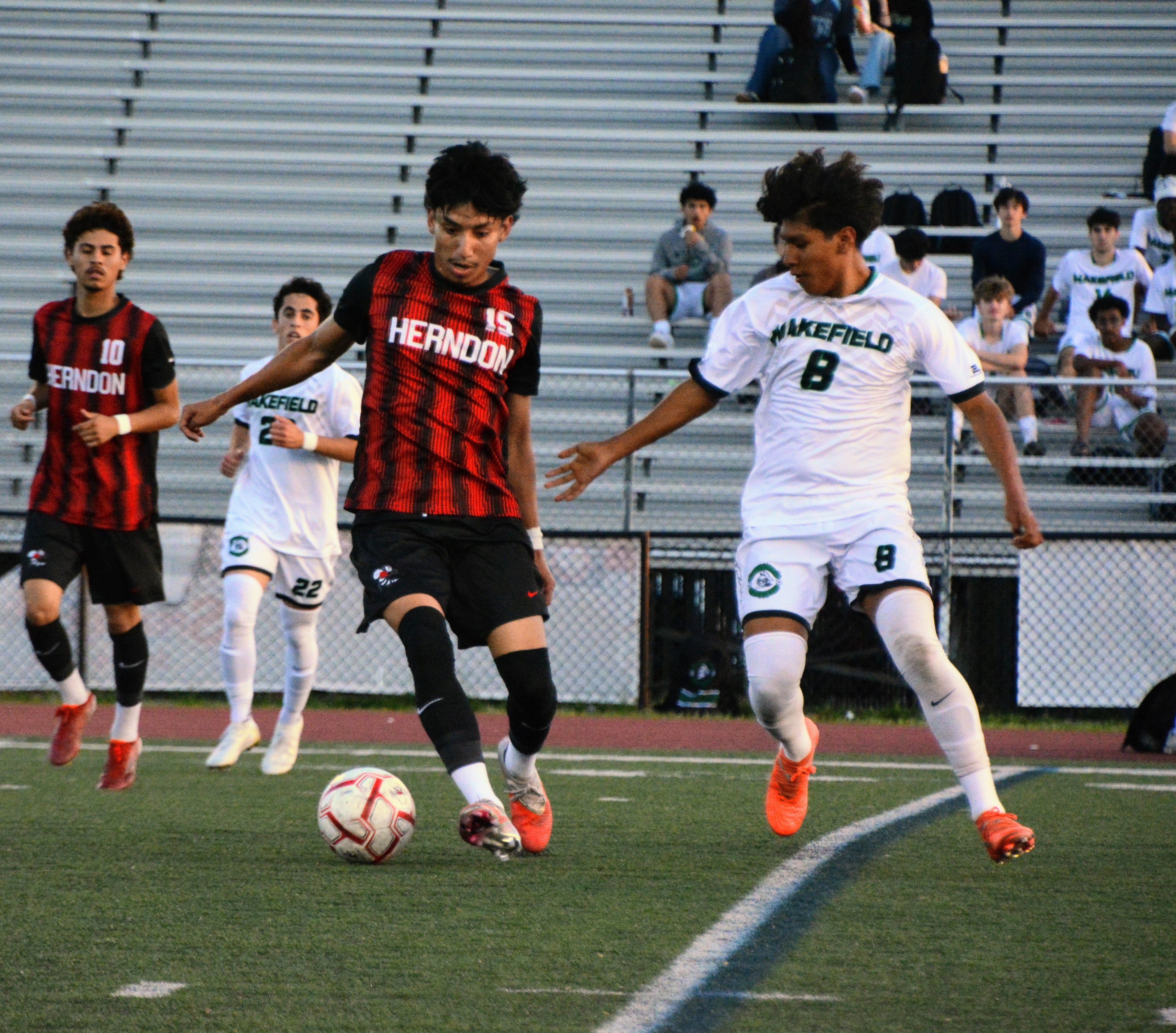
With Angel Romero and Liche Rodriguez increasingly dictating the midfield, Herndon began to control not just possession, but tempo. Their second goal came from a well-delivered set piece, Brennan Mara’s service creating just enough chaos for Andy Hercules to bundle home. The third followed a familiar pattern—pressure, movement, overload—Mequainint again the catalyst, Hercules again the finisher.
By the time a late penalty extended the lead, the result felt settled, even if the scoreline—4–1—was somewhat severe on Wakefield.
There is, though, a difference between being overmatched and being out of reach.
Herndon looks like a side capable of another deep postseason run. The pieces are not only present; they are functioning in concert. Experience has become cohesion.
Wakefield, meanwhile, remains what it was last year at its core: organized, resilient, and difficult to dismiss. Health will matter, as it does for any high school side, and so will time. Replicating last season’s run may be unrealistic—but facing them a month from now will be no simple task.
Some games are about standings.
Others are about trajectory.
This one, early as it is, suggested both.