

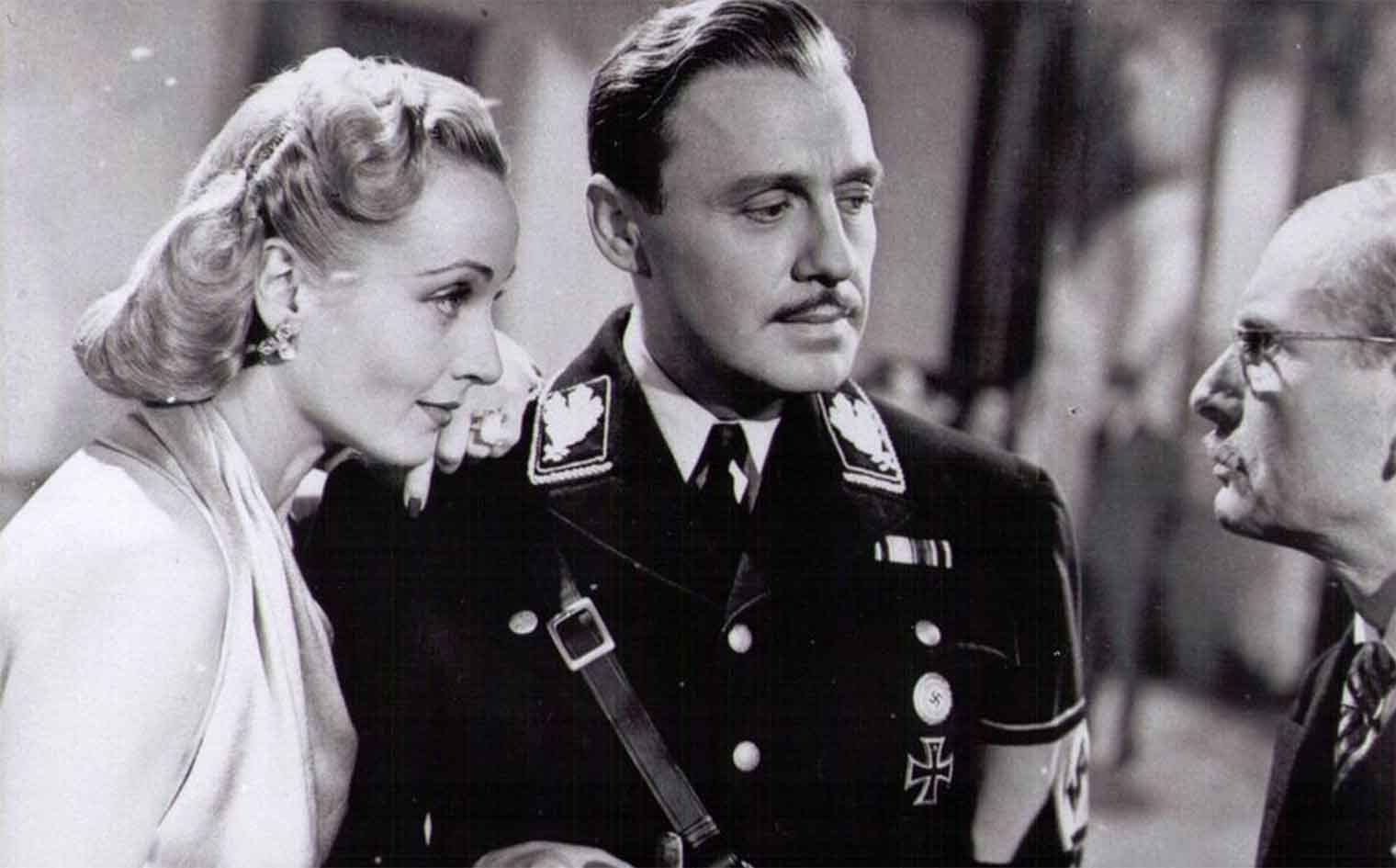
In To Be or Not to Be, Ernst Lubitsch’s great wartime comedy, Jack Benny spars with a Gestapo officer in a scene that captures the absurdity of power trying to control outcomes it no longer fully understands. The joke, like many of Lubitsch’s, is elegant: you cannot have everything at once — or, at least, not for long.
At one point, the line is delivered more bluntly: you can’t have your cake and shoot it, too.
It is a useful lens for the present moment.
As the United States applies military pressure to Iran from the air, Donald Trump also speaks of negotiation — of deals to be made, of terms to be reached. Negotiation presumes something basic: that there remains a counterpart capable of negotiating. That assumption is no longer entirely secure.
Modern warfare, particularly since the advent of air power, has made leadership itself a target. Figures once insulated behind front lines can now be removed with precision. The record is familiar: attempts on Adolf Hitler, the successful targeting of Isoroku Yamamoto, and later removals of leaders such as Nicolás Maduro, Muammar Gaddafi, and Saddam Hussein.
The theory is straightforward: remove leadership, and you weaken the state. The assumption is that disruption produces advantage.
But the practice is less certain.
Leadership decapitation does not always produce resolution. Sometimes it produces fragmentation. Sometimes it produces silence. And sometimes it produces a situation more difficult than the one it replaced: a regime without clear authority, without a recognized voice, and without anyone positioned to make or honor an agreement — and therefore no pathway to resolution.
War, in that sense, can begin to work against the very diplomacy it claims to support.
More complicated still is the timing. When conflict begins as negotiations are underway, the message to the other side is unmistakable: engagement does not provide safety. Under such conditions, diplomacy becomes not a pathway, but a liability.
If the objective is negotiation, credibility matters — as does adherence to international law, a constraint often treated as optional but essential when seeking cooperation rather than submission. And just as importantly, there must remain someone on the other side capable of deciding.
Where there are no chiefs, there may be no one to surrender — and no one to sign.
This is the tension now visible in Iran. Significant elements of leadership have been removed or weakened even as negotiations are discussed. Those who remain have incentives not to speak, not to signal, and not to expose themselves — conditions under which negotiation becomes nearly impossible. The result is a kind of strategic ambiguity that serves no one particularly well.
The temptation in modern conflict is to believe that technological superiority can resolve political problems. It rarely does. Political problems require political counterparts. Agreements require agents. Even adversaries must exist in a form recognizable enough to engage.
Lubitsch understood something about this dynamic long before modern precision warfare: power can be formidable and still be foolish when it forgets its own limits.
You cannot dismantle a system and expect it to negotiate with you afterward.
You cannot remove the decision-makers and still expect decisions to be made.
And you cannot have the cake if you have already dismissed the baker.