

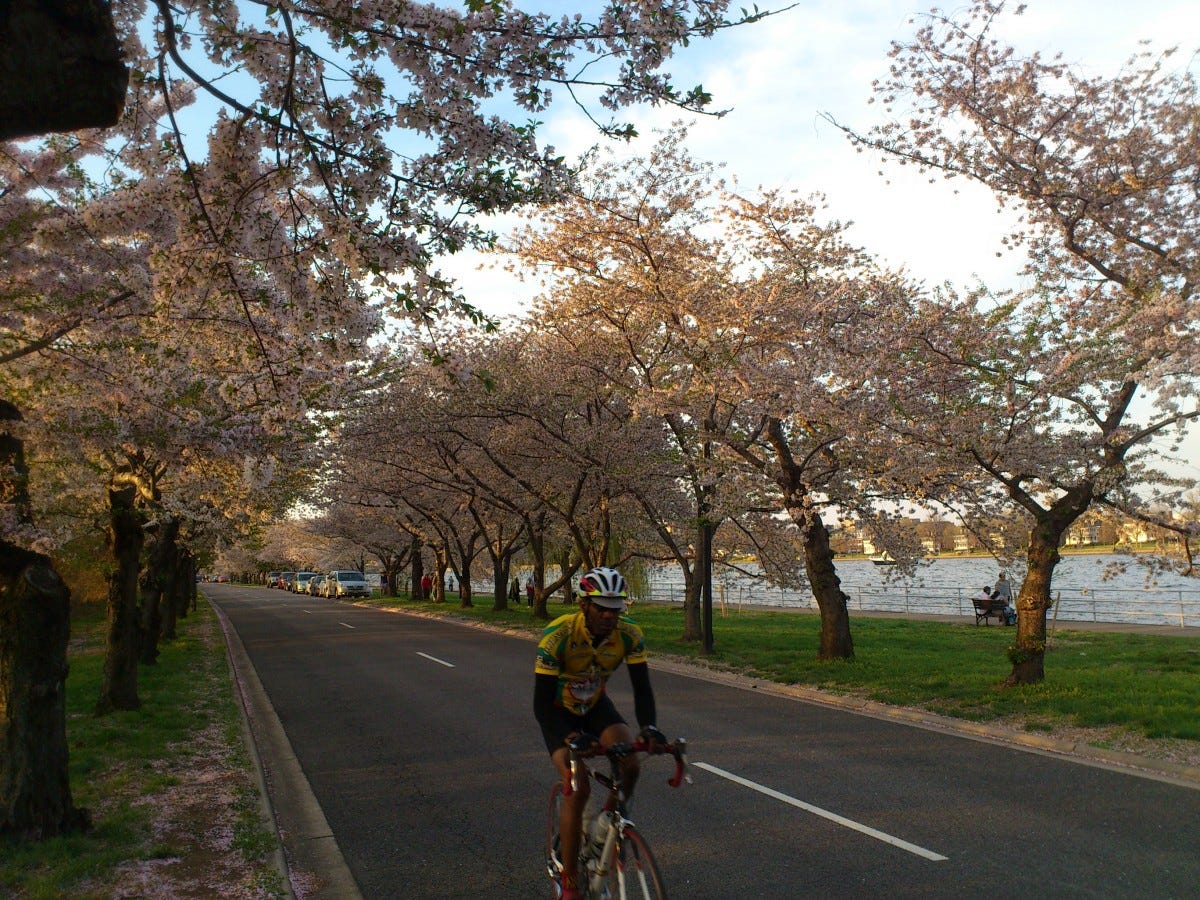
Twenty years ago, when I was cycling regularly, I would ride Hains Point every morning — and often again at lunch — circling the peninsula in that spectacular early light. Traffic was minimal. Cyclists moved fast and slow, alone or in groups. Runners and walkers traced the water’s edge. People sat on park benches looking across the Potomac. On Thanksgiving morning, runners gathered before sunrise for the annual 5K. On weekends, families barbecued, played badminton, listened to music. Serious swimmers headed to the public pool. Golfers — duffers and the occasional purist — worked their way around the course. And after dark, teenagers found quiet places to make out in their cars.
And the scenery was extraordinary: multiple varieties of cherry trees, a landscape good for the environment, good for tourism, and miraculous for daily users. Ships rested in the channel, some for the night, some for longer. All of it sat just minutes from the monuments.
Earlier this year, President Trump announced plans to transform the public golf facilities at East Potomac Park into a championship-level course. The news arrives so quickly now that outrage rarely has time to form. I did not initially realize that “East Potomac Park” meant Hains Point — one of the most spectacular pieces of public property in the country.
And the work is already underway.
More than sixty trees have been removed. The administration says the removal is routine maintenance, separate from the proposed golf-course renovation, and that the trees were hazardous, dying, or invasive. It has disputed reports about the removal of cherry trees.
The administration says a lot of things and disputes a lot of reports.
But the math is not reassuring. A championship golf course requires space, and Hains Point has only so much of it. Preliminary designs suggest golf could occupy considerably more of the peninsula. On a pancake-flat strip of land already shared by cyclists, runners, swimmers, fishermen, picnickers, trees, and waterfront paths, something has to give.
The larger problem is that we still do not really know what Hains Point will look like when this is finished. Final plans, a detailed construction schedule, and even an estimated cost have not been made public. Images of proposed designs have raised questions about the bicycle path, waterfront access, cherry trees, and other recreational uses of the peninsula.
One would think that property this remarkable would require extraordinary deliberation before being altered.
The irony is that Hains Point already had golf. It wasn’t Augusta National, and that was part of its charm. Ordinary people could play there. Meanwhile, cyclists rode around it, runners passed it, families picnicked beside it, fishermen worked the shoreline, swimmers used the pool, and people came simply to look at the water.
Nobody needed the entire peninsula.
Everyone got some of it.
That is what made Hains Point extraordinary. It was not a monument, although it sat among monuments. It was not a country club, although you could play golf there. It was not a nature preserve, although wildlife and magnificent trees surrounded you. It was simply public space — beautiful, imperfect, inexpensive, and available.
And our concern about what might happen to it does not arise in a vacuum.
This administration has already demonstrated a willingness to make dramatic physical changes to some of Washington’s most familiar places and structures. The East Wing is not an abstraction or a partisan interpretation. It is a physical reminder that things we assumed were permanent can disappear remarkably quickly.
That record matters when we are asked to trust that another extraordinary piece of public Washington will emerge intact from an ambitious transformation whose final plans the public has not even seen.
Public land is different from private property. A president may exercise enormous authority over federal agencies, but places like Hains Point belong, in a meaningful sense, to everyone. Their ordinariness is part of their value. They should be difficult to transform quickly precisely because no single administration owns them.
I rode thousands of miles around Hains Point. Other people played thousands of rounds there, caught fish there, taught children to ride bicycles there, watched the cherry blossoms there, sat on benches overlooking the Potomac, or simply did nothing at all.
None of us owned it.
That was the point.
I am not sure what will remain once the administration is finished.
Looking at recent images of the White House, it is difficult to be optimistic.