

It has long been said—perhaps with some embellishment—that Fidel Castro admired Abraham Lincoln, and that his revolution against Batista was not, at its inception, conceived as a Marxist project. Rejection, more than doctrine, may have shaped what followed. Turned away, Castro turned elsewhere, and found in the Soviet Union not only a patron, but a framework.
Cuba remains, in form, a Communist state, though one that has—over time and necessity—admitted certain market tendencies at the margins.
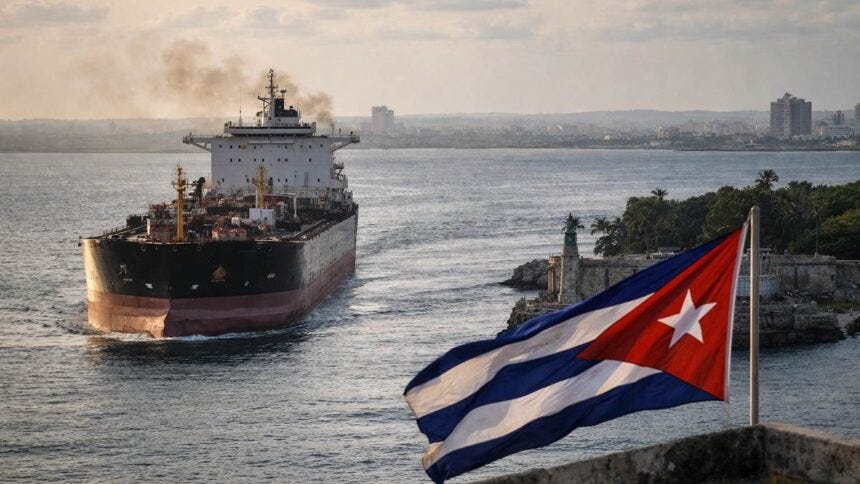
Today, the island enters another period of strain. Infrastructure, long deferred, is giving way. Sanctions have tightened. And most critically, fuel has become scarce. For decades, Cuba relied heavily on imported oil—much of it from Venezuela and, more recently, Mexico. That flow has now been sharply curtailed, in part through U.S. pressure on suppliers and restrictions on shipments.
Into that vacuum steps Russia.
In recent days, Russian tankers—carrying hundreds of thousands of barrels—have made their way to Cuba, framed by Moscow as humanitarian support amid widespread blackouts and shortages. The quantities involved are not transformative—perhaps enough to power the island for days, not months—but the symbolism is unmistakable.
It is hard to imagine the relief—however temporary—of those in hospitals trying to care for patients with limited power, or administrators attempting to give students something resembling a normal day of school. Even a week of stability can feel like a reprieve.
The question, then, is not new.
Are we, once again, pushing Cuba into the arms of a distant benefactor—not this time Soviet communism, but something closer to Putinism?
It is difficult to miss the contrast. Russia, engaged in a grinding war in Ukraine and often indifferent to infrastructure strain closer to home, extends assistance across oceans and time zones. Whether this is charity, strategy, or both is almost beside the point. The effect is the same. In geopolitics, provision precedes persuasion.
The broader landscape offers little clarity. The United States applies pressure in multiple theaters at once—military, economic, and diplomatic—while navigating entanglements with allies and adversaries whose relationships overlap in ways that resist easy categorization. Russia opposes the United States in Ukraine, cooperates selectively elsewhere, and now supplies fuel to a country under American sanction. Even as tensions escalate, channels remain open; even as lines are drawn, they are quietly crossed.
One is tempted to call it strategy. One is equally tempted to call it improvisation.
But beneath the complexity, one principle remains disarmingly simple:
A country that delivers fuel to a nation in darkness will, for a time, command more influence than one that withholds it.
The relationship between the United States and Cuba has always been complicated—historically, politically, and morally. That has not changed. What has changed is the environment in which that relationship now unfolds: one in which pressure is more diffuse, alliances more fluid, and outcomes less predictable.
Geopolitics has always been complex. It is now, perhaps, simply more visible—and less forgiving of the illusion that it can be reduced to a single line of intent.