

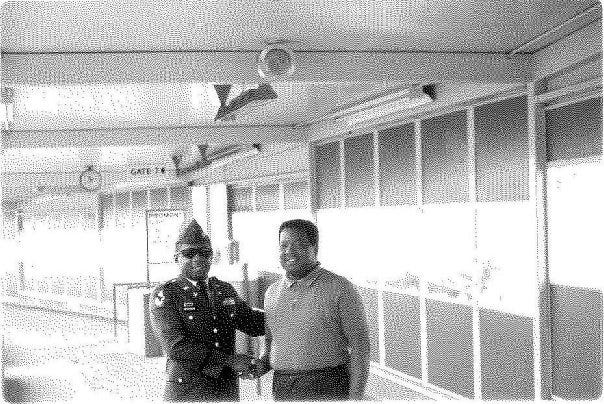
In 1963, my father, Captain Julius Brown, and his brother, Cleophus Brown—also a captain in the Army—were driving along U.S. 29 from Lynchburg toward Washington. It was not, then, an easy route for men like them. Restaurants and hotels were few, and fewer still were willing to serve.
They were, however, inclined toward mischief.
Stopping at a diner in Fairfax, some fifteen miles west of the capital, they entered and took their seats. Having both spent years stationed in Germany, they began speaking German to one another. For a moment—out of curiosity, or confusion—it appeared they might be served.
Then someone stepped outside, noticed the Virginia plates, and the ambiguity dissolved. They were escorted out—politely, but unmistakably.
It was 1963. Fairfax County still maintained segregated schools, though the first Black students had begun, cautiously, to enter previously all-white classrooms.
Eight years later, my father moved his family into that same county, eventually settling for good less than three miles from the diner.
By then, the schools were integrated. My sister and I attended Robinson Secondary School, graduating in 1982 and 1984. She was a standout on the basketball court; I was not. My own distinction was being named “outstanding student” in a massive class twice over six years, despite not having the highest grades or the most visible achievements. Robinson, a 7-through-12 school, had its own way of recognizing something less easily measured.
What we experienced there was, in its way, remarkable—not because it was perfect, but because it worked. We had a good childhood. A full one. Whatever had happened on that roadside in 1963 felt, to us, distant—almost implausible, even then. I did not yet understand how recent it had been.
Years later, I remain in Northern Virginia, having left only briefly for school at the University of Virginia. There is nothing inherently exceptional about Fairfax County. No single policy, no singular virtue, explains what happened there.
What changed was simpler, and perhaps more instructive: people encountered one another.
Given proximity, given time, given even the most modest expectation of coexistence, something shifted. Not everywhere, and not without friction—but meaningfully, and at a pace that, in retrospect, feels almost improbable.
Progress, we are often told, is slow. And often it is. But under the right conditions, it can move with surprising speed.
Which is both encouraging—and cautionary.
What can move forward can also, if neglected, move back.
Still, for those of us who grew up there, it was a good place to be young. And, in ways that matter more over time, a good place to learn how change—quiet, imperfect, but real—can take hold.