

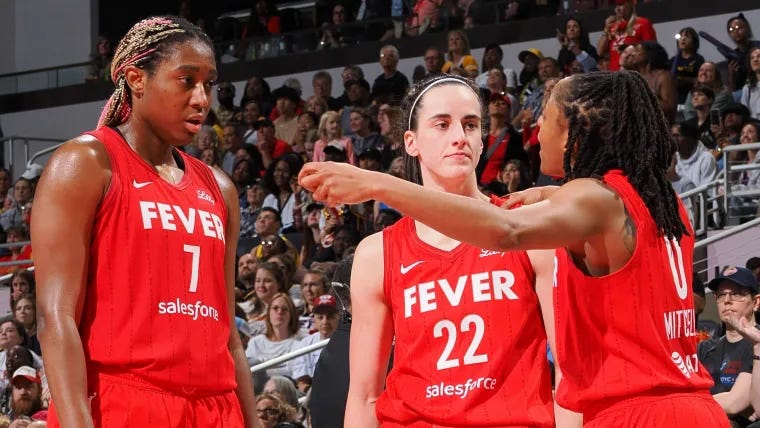
The Indiana Fever find themselves navigating one of the more delicate moments in modern sports.
Women’s basketball is enjoying a genuine breakthrough. College and professional games are drawing enormous crowds, television audiences have grown dramatically, and elite players are earning salaries and endorsements that would have seemed fanciful a decade ago. Much of that momentum can be traced, directly or indirectly, to the arrival of Caitlin Clark, the fiercely competitive Iowan whose thirty-foot shooting range and extraordinary court vision have made her one of the most compelling athletes in America.
Her professional career has begun much as her admirers expected: brilliantly.
Yet success has brought complications.
The Fever’s fan base has expanded dramatically, attracting many newcomers whose attachment to the team begins and ends with Clark herself. Clark has also acquired fans whose interest in her seems inseparable from a larger cultural argument about the WNBA, a predominantly Black league with a long history of progressive activism.
None of this appears to be Clark’s doing. She has largely confined herself to playing basketball with extraordinary intensity while other people attach meanings to her that she has never claimed for herself.
The presence of Sophie Cunningham, who has become something of a MAGA-adjacent folk hero in certain corners of the internet, adds another layer to the dynamic.
Kelsey Mitchell has now spoken openly about the difficulty of playing for fans who may not particularly like her. She has described hateful messages and the additional scrutiny that comes with being Caitlin Clark’s teammate. Aliyah Boston has also spoken previously about the hostility she has received from people identifying themselves as Fever fans.
Neither woman enlisted in the larger cultural argument surrounding Clark.
But they are absorbing some of the stray fire.
None of this is particularly new.
Bill Russell won eleven championships in Boston and remained deeply ambivalent about the city that celebrated his victories while often making him feel unwelcome. Celtics fans desperately wanted Russell to grab the rebound, block the shot, and win another championship. Russell was never convinced that meant they particularly wanted Bill Russell.
It is one of the stranger things about sports. A fan can desperately want you to make the shot without particularly wanting you at his dinner table.
Sports fandom can temporarily override prejudice. It does not necessarily cure it.
A generation later, Boston offered a different version of the same complication. By the time Larry Bird entered the NBA, the league had become predominantly Black and was struggling to hold a broad national audience. Bird and Magic Johnson changed that. Their rivalry helped bring enormous numbers of fans back to professional basketball, including white fans who saw something particularly compelling in Bird.
There was nothing inherently racial about Bird himself. He did not need to say anything racial for race to become part of the story others told about him.
Boston Garden was overwhelmingly white and famously brutal to visiting teams. Magic Johnson and Kareem Abdul-Jabbar did not need to decide exactly what portion of the hostility was racial. They mostly wanted to shut the crowd up.
There is something familiar in that now.
I noticed a particularly unsettling version of this years ago while watching CSKA Moscow. Black stars such as Vágner Love and Ahmed Musa could score important goals, yet there were occasions when their Russian teammates seemed reluctant to celebrate with them in the usual way. I never took that as evidence that the players themselves were prejudiced. My impression was almost the reverse: they understood that parts of their own support might object to too conspicuous an embrace of a Black teammate.
If so, the remarkable thing was not simply that prejudice existed in the stands. The players had learned to accommodate it on the field.
Mitchell’s recent comments suggest that contradiction is not merely theoretical.
From a distance, it is tempting to say: cash the checks, play the games, and ignore the noise. Professional athletes are well compensated, public criticism comes with the territory, and no fan base is entitled to universal approval from the people wearing its uniform.
But human beings are not particularly good at permanently compartmentalizing the forces acting upon them.
Russell never entirely made peace with Boston.
Mitchell may eventually decide that Indianapolis is precisely where she wants to remain. Boston may feel differently about the environment than Mitchell does. Neither player’s future needs to be predicted to recognize what is happening around them.
They are important players on a team whose sudden popularity has brought millions of new admirers — along with arguments about race, politics, gender, and culture that neither created.
Sometimes the basketball gets lost in all that noise.
If Mitchell leaves, some of the people who complained about her may discover how much they miss her.
Sports fans have been known to make such discoveries.