

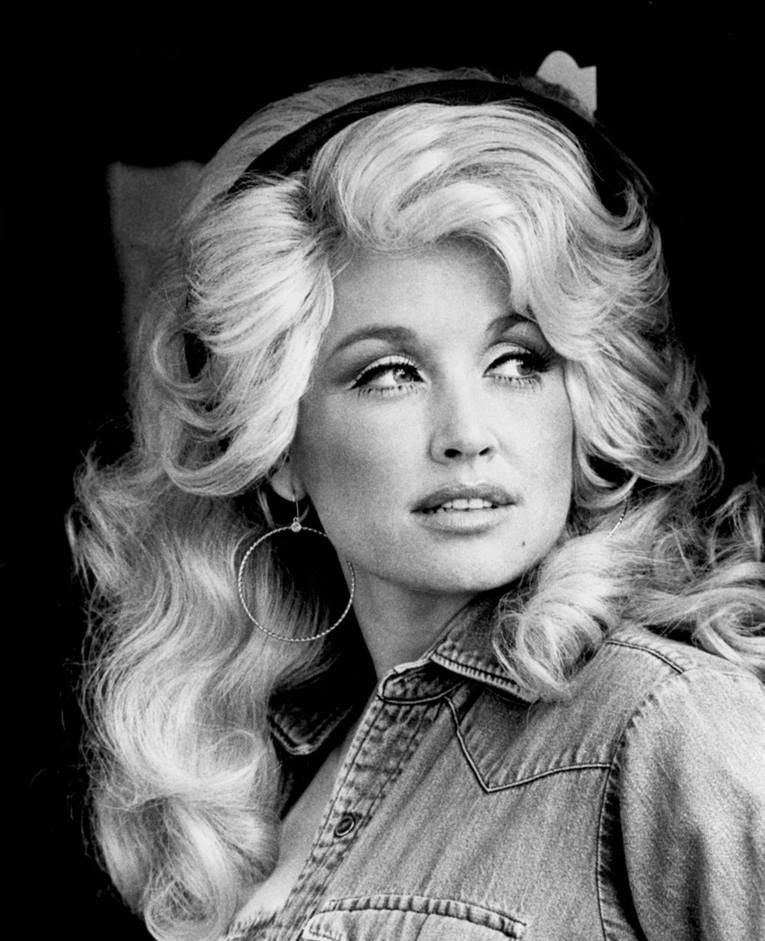
I first discovered Dolly Parton as a fourteen-year-old, watching her hilarious turn in 9 to 5, resisting Dabney Coleman with a confidence that felt all too real. I was in love, of course — but she was far too much for me, and frankly too much for anyone. That was part of the charm.
My sister was the true devotee. She played “Two Doors Down” endlessly, a sweet little Dolly confection, and reminded me that Parton wrote one of the most remarkable songs in American pop culture, “I Will Always Love You” — already a country classic before Whitney Houston carried it into another universe.
Dolly made everything look easy. A marriage that lasted nearly sixty years. A deliberately outrageous public persona that she somehow carried effortlessly for six decades. An ability to address social issues — gay rights, LGBTQ equality, even trans issues — without alienating the conservatives who formed a large part of her fan base.
She understood the joke without ever becoming the joke.
When asked about plastic surgery, she famously quipped, “It costs a lot of money to look this cheap.” That was Dolly: self-aware, disarming, and nearly impossible not to love. The hair, the rhinestones, the figure, the clothes — she got there before anyone else could. Nobody could embarrass Dolly Parton by pointing out that Dolly Parton was over the top. She had already told you she was.
Behind all that artifice was an exceptionally serious songwriter, businesswoman and philanthropist. Her Imagination Library gave away books to children by the hundreds of millions, somehow without turning generosity into a self-congratulatory brand. What began in her home county in Tennessee eventually reached children around the world.
She remained fiercely loyal to Tennessee even as she became a star in Hollywood, music and business. Her story is not extraordinary simply because of her talent, beauty, charm or kindness — though she had all of them in abundance.
It is extraordinary because of the simple things.
She became one of the most recognizable people in the world and remained rooted in the same place. She shared nearly sixty years with the same man. She carried herself with a humility that rarely felt manufactured. She could laugh at herself while taking her work seriously.
The artifice was enormous.
The person underneath it seemed remarkably unaffected.
RIP, Dolly.
Lovely article, Julian.