

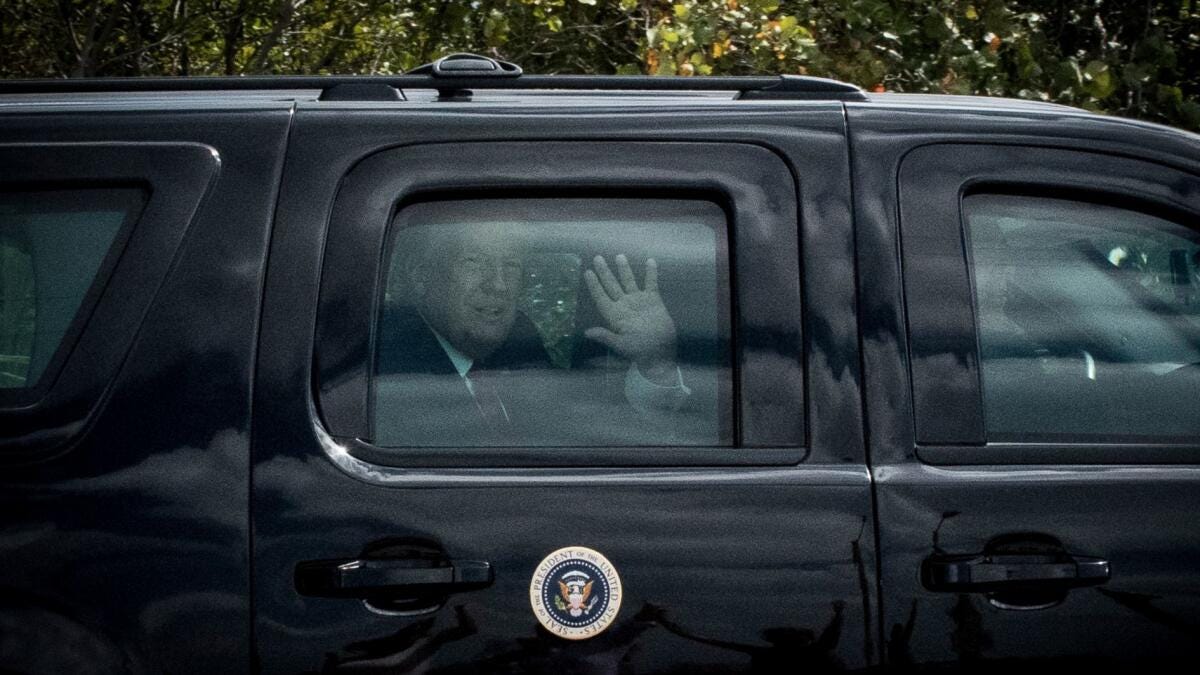
I live near the Trump golf resort in Loudoun County. When the president travels there, traffic can stop for hours as the motorcade passes. Roads close, intersections freeze, and ordinary movement pauses until the procession is gone.
Working in Washington brings a similar experience. When the president moves through the city, large corridors of streets are secured hours in advance. Barricades appear long before the motorcade arrives, and whole sections of downtown effectively stop functioning until it has passed.
Security explains the precautions. But the effect is unmistakable: the president rarely encounters the country in its ordinary condition.
Distance becomes built into the office.
Another kind of distance can emerge inside the White House itself. Administrations always rely on loyal advisers, but this one appears unusually narrow. Critics describe an environment that is more sycophantic than most, where advisers tend to reinforce the president’s instincts rather than challenge them. It bears little resemblance to the “team of rivals” model sometimes celebrated in American political history.
The biography of any leader shapes how he understands the country he governs. Donald Trump’s path to influence was unusual even by presidential standards. His wealth began with inheritance and expanded through licensing deals, high-risk ventures, and bankruptcy restructurings unavailable to most Americans. He avoided military service during the Vietnam era because of bone spur deferments.
None of this alone determines how someone governs. Many presidents have come from elite or unconventional backgrounds.
But leadership requires something more than instinct.
It requires curiosity about the world beyond one’s own experience.
Presidents differ in how they absorb information. Some read deeply and rely heavily on detailed briefings. Trump has often been described as the opposite — a leader who prefers short summaries, conversation, and instinct. Supporters see decisiveness in that style. Critics see impulsiveness.
Yet the decisions made at the presidential level are rarely small ones. They shape trade policy, civil liberties, and the nation’s role abroad. Increasingly they also involve sweeping judgments about other societies.
If a war sends gasoline prices soaring, the president feels it in the polls. The public feels it at the pump — and then in groceries, rent, and everything else that follows.
In recent months the administration has spoken openly about reshaping political outcomes in places like Iran and Cuba. Military pressure, sanctions, and even suggestions of regime change have entered the conversation. These are not minor decisions. They involve judgments about cultures, histories, and political systems far more complex than any single leader can fully grasp.
Foreign policy has always required difficult choices. The United States has often attempted to influence events abroad.
But successful diplomacy has usually begun with a simple discipline: trying to see the world through the eyes of others. Strategists like George Kennan argued that understanding an adversary’s perspective was essential to avoiding catastrophic miscalculation.
Insularity makes that harder.
When decisions about distant societies are made within a small and unusually loyal circle — and by a leader whose life experience has been far removed from ordinary Americans — the risk grows that those judgments will be made with too little knowledge and too much certainty.
Americans are generally optimistic about their country and its leaders. That optimism is one of the nation’s strengths.
But optimism also depends on confidence that those guiding national policy understand the complexity of the world they are trying to shape.
Concern arises when that understanding appears thin.
When power moves through motorcades, barricades, and carefully managed circles of advice, it becomes easier for leaders to forget the ordinary world outside them.
And it is that ordinary world — at home and abroad — that ultimately lives with the consequences of their decisions.