Donald Trump has long shown an affection for conspiratorial suggestion—whether revisiting the Kennedy assassination, flirting with moon-landing skepticism, alleging fake birth certificates, or popularizing the phrase “fake news.” He understood something important about modern politics: suspicion can be more useful than proof.
The phrase itself did more than challenge questionable reporting. It gradually expanded to include reporting that was merely inconvenient. In time, the term escaped its original context and entered the global vocabulary of political grievance. Leaders elsewhere learned the lesson quickly. If facts prove troublesome, discredit the institution that reports them.
The erosion of trust, to be fair, did not arise from rhetoric alone. Media organizations have made errors of their own, sometimes serious ones. But opportunists have learned that institutional mistakes can be repurposed into something larger: not criticism of specific failures, but suspicion of the very possibility of honest reporting.
It should also be remembered that skepticism toward institutions did not begin with Trump. Many Americans—particularly minorities who experienced unequal policing, discrimination, or official neglect—had long learned that authority could be unreliable. Trump did not invent distrust. He nationalized it, personalized it, and turned it into a governing instrument.
This creates a difficulty for those who prefer not to inhabit the more fevered corners of public life.
For real conspiracies do occasionally exist. Governments conceal, institutions fail, narratives are managed, and inconvenient truths are sometimes delayed. But once suspicion becomes a permanent style of politics, the ordinary citizen is left in an impossible position: to question anything is to risk sounding unserious; to question nothing is to become naïve.
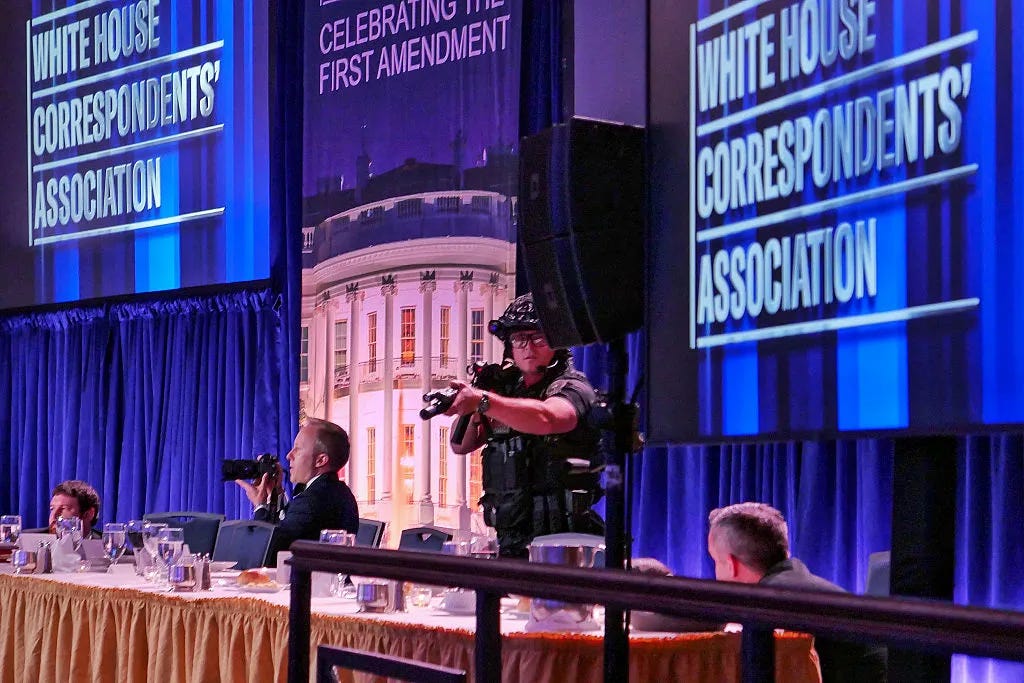
Reports this weekend of a security disruption at the White House Correspondents’ Dinner illustrated the problem. Early accounts described an unstable intruder breaching security at an event attended by senior officials, prominent journalists, and figures who ordinarily move within concentric circles of protection, causing visible alarm in the room before later descriptions grew less certain.
As so often happens now, certainty lagged behind narrative. Details were partial, interpretations immediate, and confidence abundant long before facts were settled.
Perhaps the explanation will prove mundane: an isolated lapse, an overstated early report, the inevitable imperfections of any large security operation. Perhaps something more serious occurred. The full account remains less clear than the commentary surrounding it.
Still, skepticism in such circumstances is not irrational.
Those who live in the Washington region know the scale of security mobilized when a president moves even casually through the area. Roads close. Traffic stalls. Entire sections become temporary fortresses. In Northern Virginia, one can feel the presence of presidential travel miles away. That backdrop makes any reported breach at a heavily protected venue naturally difficult to dismiss without inquiry.
There is another layer of cynicism as well. This administration has often appeared unusually cozy with segments of the media establishment—something Trump himself has periodically boasted about when convenient. Whether exaggerated or not, such familiarity deepens public suspicion when incidents involving both government and press are quickly wrapped in reassurances.
None of this requires conspiracy thinking. It requires only the willingness to ask proportionate questions while awaiting proportionate answers.
What follows such episodes is often as revealing as the episode itself. Before details settle, narratives form. Social media fills with certainty from every direction. Allies defend, opponents speculate, and everyone arrives early at conclusions for which evidence has not yet emerged.
We have, in effect, trained ourselves to live beyond verification.
That may be the most enduring legacy of the “fake news” age. Not merely distrust of media, but distrust of the very possibility of settled fact. Every event now comes pre-divided into competing realities, each ready for consumption before the first credible account is complete.
The old fable warned of the boy who cried wolf. Our variation is more modern.
We have cried “fake” so often that when something genuinely strange occurs, no common standard remains by which to judge it.
So we choose sides quickly, argue briefly, and proceed to the next spectacle.
Which is to say: the disorder is no longer the interruption.
It has become the atmosphere.