

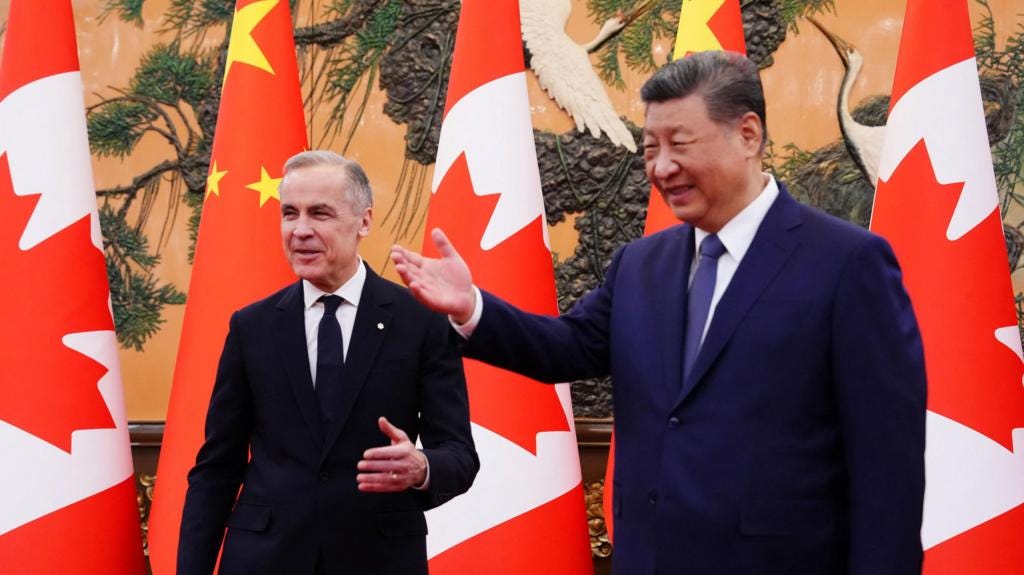
In this week’s speech at Davos, Mark Carney, speaking with his customary seriousness, outlined what he sees as the emerging threats to global peace and prosperity—and the partnerships required to confront them. He spoke of deepening ties with Europe, South America, Australia, and, notably, China. That final inclusion was not casual. China is now a global power that many countries, however warily, feel compelled to engage.
It would be difficult for anyone to defend all that China does internally. Its repression of minorities, environmental record, population policies, and restrictions on political freedom make it an unattractive place for most of us to live. Its posture toward Hong Kong and Taiwan is coercive, and its neighbors understand the risks of proximity to such power. Few would trade life in an open society for Beijing’s version of order.
And yet, internationally, China conducts business with a consistency and seriousness that many governments find increasingly attractive. It shows up. It negotiates through institutions. It signals clearly. Like all great powers, it seeks to expand its economic reach—but it does so methodically, and often more competently than its rivals.
That Canada would now look toward China, even cautiously, is therefore not surprising—though it is telling. The shift is reluctant, not ideological. It reflects growing unease with an American partner that has become erratic and, at times, openly hostile. This is not only about tariffs or immigration policy, but about the casual talk of military action, threats against allies, and even suggestions that sovereign nations—Greenland, Canada itself—might be absorbed or coerced.
What increasingly separates the United States from China in the eyes of other governments is not ideology, but professionalism. When American foreign policy arrives by late-night post or impulsive declaration—entangled with grievance or bravado—and is contrasted with the deliberate formality of China’s public posture and disciplined chain of command, the choice becomes easier for risk-averse states. One may distrust China’s intentions; one can at least identify its method.
The world understands that all great powers pursue self-interest. What it cannot manage is unpredictability masquerading as strength. When talk of Nobel Prizes is paired with threats of territorial acquisition, when alliances are treated as favors rather than obligations, credibility dissolves quickly.
Some countries may decide they can live with a Chinese sphere of influence, just as they once accommodated an American Monroe Doctrine—especially if China’s conduct abroad appears steady, transactional, and institutionally legible. That calculation is not an endorsement of Beijing’s values. It is an indictment of Washington’s behavior.
This is the quiet recalibration now underway. Nations are not choosing China because they admire it. They are choosing it because professionalism, however self-serving, has begun to look like a virtue again. Until the United States relearns the difference between power and performance, it should not be surprised when others decide to do business elsewhere.