

I have never been entirely comfortable with nationalism in sport.
Part of the reason is how early I learned that sports pride was rarely simple. My father served two combat tours in Vietnam — proud to serve his country, yet aware that the dignity he experienced abroad was not always guaranteed at home. As a child I learned to celebrate the Jesse Owens of 1936 and later struggled to interpret the raised fists of Tommie Smith and John Carlos in 1968. Even triumph could carry tension. The same nation could cheer an athlete and still argue over what his success meant.
In 1980 I felt the same surge of pride as millions of Americans watching the United States defeat the Soviet Union in Olympic hockey. Yet a decade later Roger Milla’s World Cup celebrations for Cameroon captivated me just as completely. When Ghana eliminated the United States in 2010, I did not experience it as defeat. For many African Americans, connection to African teams is not colonial memory but historical kinship — a recognition of a past both painful and shared. Identity does not always align neatly with the political nation-state.
We sometimes cheer the uniform, sometimes the individual, sometimes a story larger than either. The tension begins when an athletic contest becomes proof of national virtue. Competition belongs to sport. Moral judgment does not.
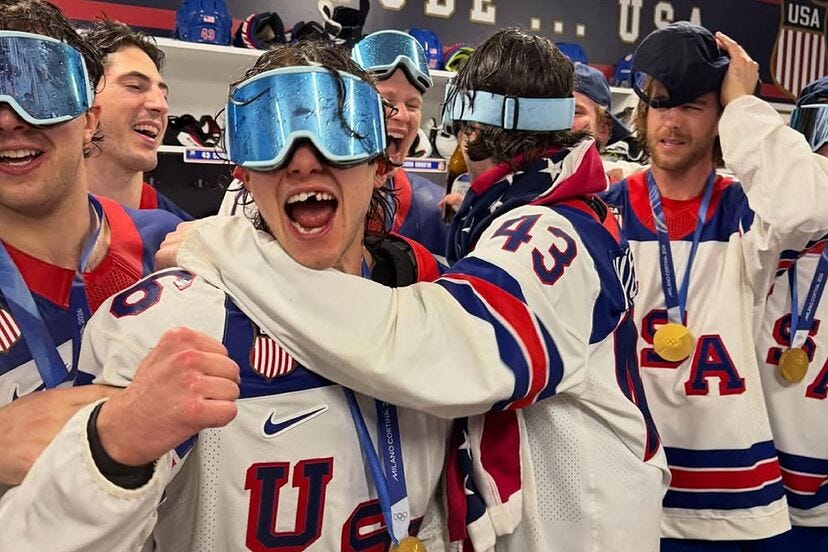
Which is why a recent Olympic hockey victory over Canada struck me differently than expected. I was surprised by how intensely some friends celebrated it. What surprised me most was my own reaction: I was quietly pulling for Canada, not against my country but toward something I felt the game was no longer about. Canada is not merely an opponent across the ice. It is a country that has stood with us in wars and alliances, often without fanfare and sometimes even before we acted ourselves. The sudden intensity of rivalry sounded less like sport and more like forgetting.
When political figures appear in locker rooms or teams become symbols in domestic arguments, the game changes character. The contest is no longer only performance. It becomes a vessel for meanings the athletes did not choose. Nations bring history onto the ice whether the players intend it or not.
International competition therefore asks a quiet question: what exactly are we cheering? At its best we celebrate excellence — speed, precision, and composure under pressure. Yet it is easy to shift from admiring a performance to affirming a nation.
I have come to prefer international sport when it centers the athlete rather than the state, when rivalry remains intense but not existential. One may admire an opponent without disloyalty, just as one may respect another country’s success without diminishing one’s own.
Sport is one of the few places where rivalry need not become hostility. Different nations meet under shared rules, compete fiercely, and then part peacefully.
We do not have to choose between appreciating our country and respecting another. The game ends; the relationship remains.