

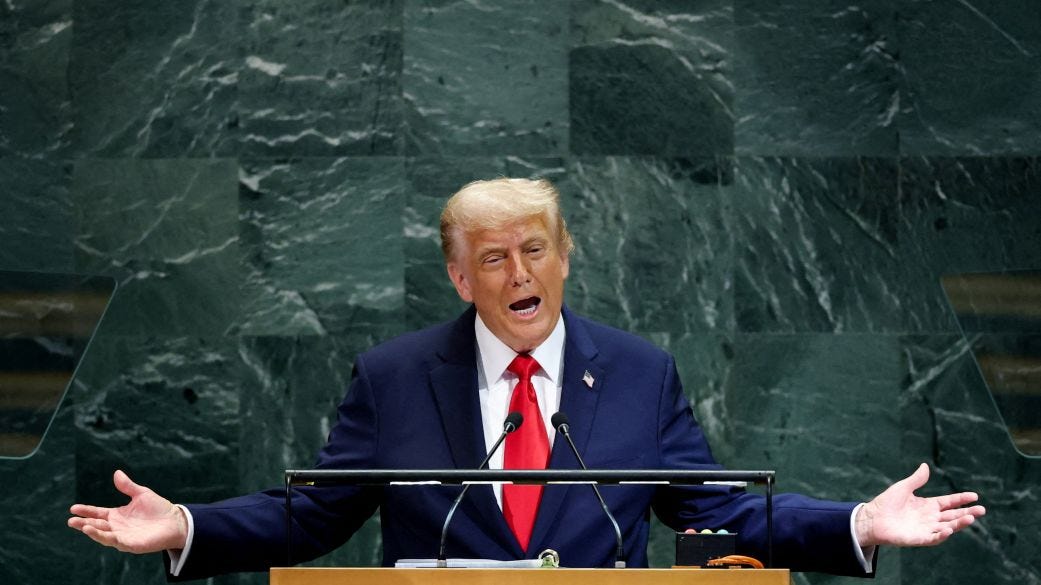
President Trump’s address to the United Nations this week felt less like a speech to the world than an open‑ended conversation with himself — a far‑ranging monologue in which he debated whether to “annihilate” Iran, mused about intervention in Cuba and Venezuela, and wandered through a catalogue of grievances and ambitions. It was a missed opportunity. The UN is the one forum where a president can explain to every nation why military action might be necessary, why tariffs are justified, or why American leadership still matters. If the message is simply that the United States has already decided and everyone else must fall in line, one wonders why the UN was needed at all.
The contrast was striking. While Trump described Iran’s leaders as irrational, their representatives delivered a more traditional diplomatic speech — leaving many observers to wonder which side sounded more measured and which more volatile.
The deeper problem is that America has withdrawn from the soft‑power game in Trump II. The administration’s rhetoric at the UN does not merely fail to build consensus; it actively undermines it. If the goal is to create a world in which hard power is the only currency, we are well on our way. But hard power is not free. The conflict with Iran consumes American resources, attention and legitimacy. Influence is a form of power too, and we are losing it.
Trump may impress his domestic supporters. But other nations have interests that do not intersect neatly with his. Soft power depends on persuasion, predictability and restraint — qualities that cannot be replaced by volume or bravado.
Many Americans like to believe the world understands that Trump does not speak for all of us. And perhaps that was true once. During the Biden years, allies reengaged with the United States and seemed to assume that the Trump era would not last forever. But we have now elected Trump twice, and he appears to be consolidating power across institutions. That is not a one‑off. It is a pattern.
The old grand bargain — the assumption that America would lead because of what it had done in the twentieth century — is fading. Influence is no longer a presumption. It is a task. And like every other nation, we will have to earn it back one decision at a time.
Without that presumption, America becomes something unfamiliar:
not the indispensable nation, but simply another nation.
We may discover that the world has not left us.
It is we who have left the building.