

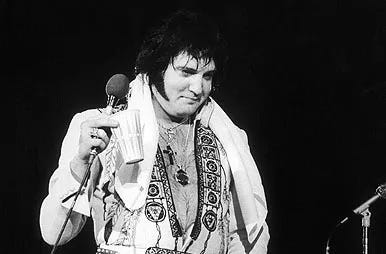
Donald Trump appeared at Graceland yesterday, and the scene carried an unintended echo. The setting, the staging, even the atmosphere called to mind Elvis in his final years—still commanding attention, still surrounded by loyalty, but no longer quite what he had been.
In Trump’s case, power has not receded with that change.
It has concentrated.
In recent months, his ambitions have taken on a more architectural form—arches, coins bearing his likeness, a remade Kennedy Center, new flourishes at the White House. These are not merely preferences. They are signals.
They have emerged at the same moment the United States is engaged in an open-ended conflict with Iran—where outcomes are uncertain, and commitments difficult to unwind.
The juxtaposition is striking.
And those closest to him, one suspects, are beginning to ask a quieter question:
What comes next?
The answer is not obvious, and that uncertainty is the story.
For Republicans—and for those who have aligned themselves with Trump’s version of executive power—the dilemma is structural. The modern presidency now carries authorities that would have seemed extraordinary not long ago: a more compliant media environment, a corporate sector inclined toward accommodation, expanded latitude in matters of security and force.
These are tools that serve a president well.
They are also tools that, once created, do not easily disappear.
Which raises an uncomfortable prospect. Power accumulated for one leader does not remain his alone.
Those who have helped construct this environment may find themselves less enthusiastic when imagining it in other hands—whether those hands belong to a rival faction within their own party or to an opposition they have spent years resisting.
The struggle to succeed Trump will therefore not be orderly.
There is no clear heir. The field is crowded with ambition: family members, Vice President J.D. Vance, senators, and media figures who have learned to command audiences as effectively as any politician. Layered on top is a live war in Iran—an open-ended conflict involving American force, uncertain objectives, and consequences no one can fully map in advance.
Many will want the office. Many will prefer that their rivals do not have it.
The result will be a struggle that is both intensely personal and quietly existential.
And yet, once it concludes, unity will likely follow.
Parties that accumulate power rarely surrender it voluntarily. After years in which the lines between governance, advantage, and self-preservation have blurred, the incentive to hold together will be strong—particularly if the alternative is a transfer of power that brings scrutiny with it.
Democrats, for their part, do not lack for capable figures. Governors such as Gavin Newsom, Gretchen Whitmer, and Josh Shapiro, along with figures like Pete Buttigieg, represent a deep bench. Under ordinary conditions, such a field would produce a competitive and substantive race.
But these are not ordinary conditions.
If the media environment continues to shift from scrutiny toward affirmation, traditional markers of qualification—experience, temperament, command of policy—may matter less than the ability to shape perception.
Campaigns are no longer simply contests of ideas.
They are contests of narrative control.
And narrative, once untethered from shared standards, can be constructed.
Which brings us back to Graceland.
The image of a dominant figure, still at the center of attention yet increasingly surrounded by a system built in his image, is not merely a curiosity of style. It is a moment in a larger transition.
The question is not only how long such a figure can remain central.
It is what remains when he is not.
The struggle that follows will be absorbing. It will also be consequential.
Because the real contest will not simply be over who inherits power.
It will be over what kind of power is left to inherit.