

Soccer can be a harsh game when it comes to punishment. A red card means banishment: the player is removed, cannot be replaced, and is automatically suspended for the next match. It is reserved for fouls of an egregious level or for two yellow cards judged more serious than ordinary infractions.
In the Round of 32, U.S. striker Folarin Balogun was involved in a challenge on a Bosnia defender. The referee initially allowed play to continue, but VAR intervened, recommending an on‑field review. After watching the replay, the referee upgraded the decision to a straight red card. Under the rules, Balogun—a star for first division French team Monaco and scorer of three goals for the US in World Cup—would miss tonight’s match against Belgium.
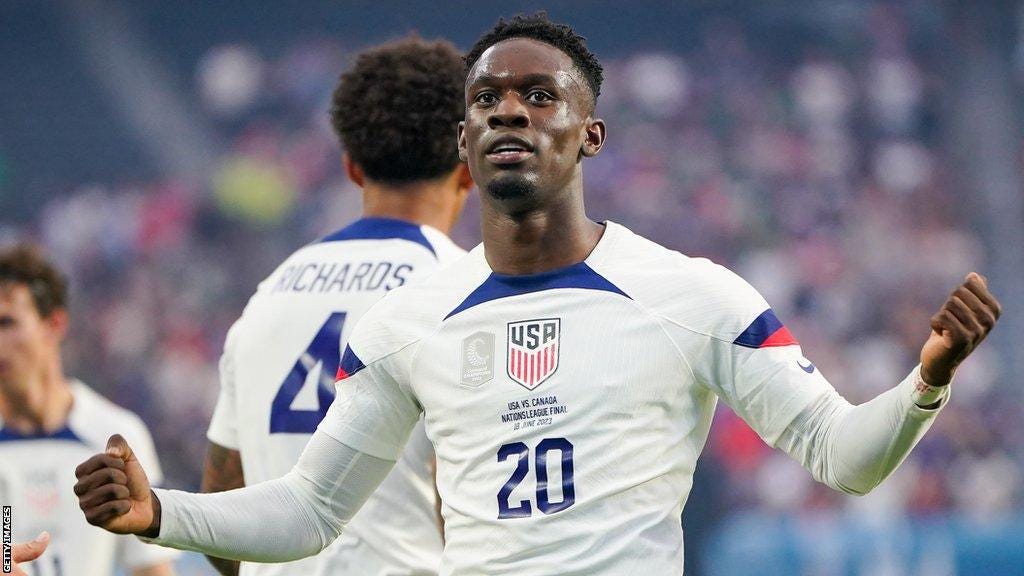
On Sunday, FIFA invoked a clause allowing flexibility in disciplinary decisions, clearing Balogun to play.
President Trump publicly praised the reversal soon after. Media reports suggested he made a personal call on the matter. His relationship with FIFA president Gianni Infantino has been visible for some time, most notably during the 2025 Club World Cup—widely seen as a dress rehearsal for this tournament—and the awkward moment when a Chelsea player had to ask Trump to step aside from the podium so the team could celebrate. Infantino was widely criticized for that episode, and for the relationship that produced it.
The original red card was not impulsive. It was made with deliberation, and the contact fell well within the definition of serious foul play. As with all such decisions, it is easy to second‑guess, because red cards are harsh by nature and because fans can always point to occasions when similar contact went unpunished. But this call was comfortably within the referee’s discretion.
What is not discretionary is the automatic suspension that follows. “Historians” of the sport often cite 1962, when Brazilian great Garrincha was allowed to play after a red card. But pointing to the rule itself—and to every other occasion—makes that precedent difficult to defend. And having the president of the host nation rumored to have intervened is a terrible look for a sport that insists on neutrality.
The timing is politically fascinating. Last week, President Trump expressed frustration that the Supreme Court did not overturn birthright citizenship, despite the clear language of the Fourteenth Amendment stating that those born in the United States are citizens. Balogun was born in New York to Nigerian parents traveling from London; when his mother was deemed too pregnant to fly, he was born here. It is touching, in a way, to see him celebrated, even defended and advocated for. But athletes, entertainers, and the wealthy often find themselves exceptions to rules that bind everyone else.
The words of the Fourteenth Amendment are straightforward. The rule governing red‑card suspensions is even more so.