

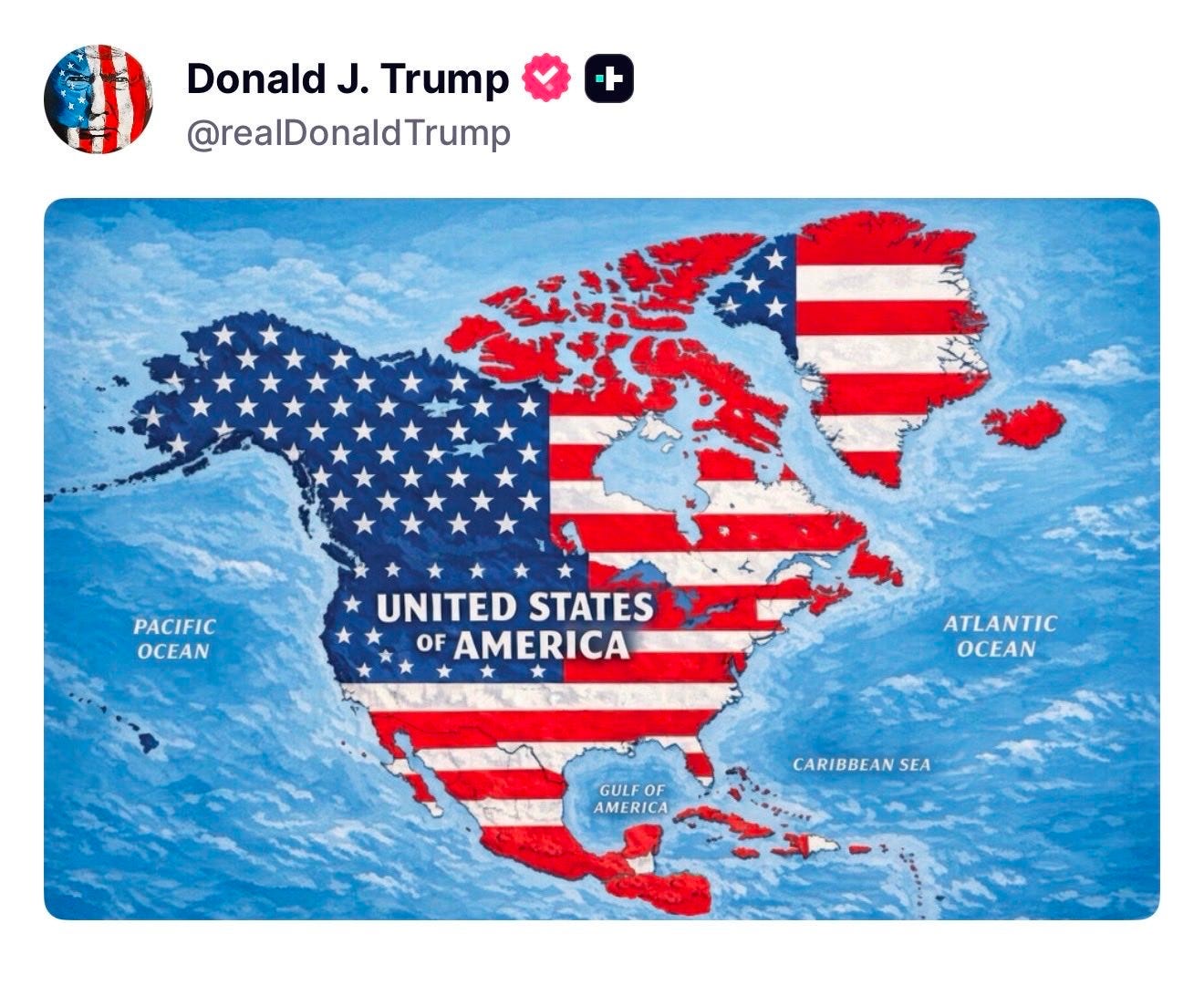
Last week, Donald Trump posted an image on social media showing much of North America and the surrounding region under the American flag. It followed years of calling Canada the “51st state,” talking about acquiring Greenland, and, more recently, American demands that Canada says threatened its sovereignty and protections for the French language. It arrived amid an immigration policy in which people are not necessarily being returned to their home countries but can instead be sent to third countries, including in Africa. And it came during another round of forced departures among senior military leadership, many without public evidence of wrongdoing.
It is one thing to talk about annexation.
It is another for the president of the United States to circulate a map depicting sovereign nations beneath the American flag.
The map implies an expanded United States. Whether Trump could achieve such a thing, or intends to try, is another question. But if a president puts such an image before the public, we are entitled to consider the world he has asked us to imagine.
And it is not a particularly pleasant exercise for minorities already living within the United States.
Maps make expansion look remarkably simple. Change the colors. Move the borders. Add the flag.
People are more complicated.
If Canada becomes part of the United States, Canadians do not disappear. If Greenland becomes American, Greenlanders do not disappear. Neither do their political institutions, languages, Indigenous communities, immigration laws, health systems, national identities, or ideas about citizenship.
And neither do ours.
If Haitians are denied status here, where do they go in a continent increasingly brought under American authority? We are already sending some immigrants not merely to countries they are not from, but to countries outside even the vastly expanded United States depicted on the president’s map. If Greenland becomes “American,” are Greenlanders automatically citizens? Do they retain their own immigration laws, or does American policy govern them? Would American detention and deportation policies simply extend across the new territory? What happens when people accustomed to government-provided health systems suddenly find themselves governed by a country with an entirely different conception of health care, with the $500 deductible?
These are not objections to a plan. No such plan has been presented.
They are questions raised by the map itself.
A few years ago, observers began wondering why American negotiators increasingly appeared to share Russian assumptions in discussions about Ukraine. Had the United States changed sides?
Perhaps that question was too narrow.
A government willing to treat the sovereignty of allies as negotiable presents a more unsettling question:
What side are many of us allowed to be on?
The map depicts a continent unified beneath a single flag. Recent American policy provides reason to ask what life beneath that flag would mean.
That is the part expansionist imagery tends to leave out.
Territory is not merely land. Canada is not acreage. Greenland is not acreage. Mexico is not acreage. Countries are people — people with governments, languages, histories, rights, expectations, and loyalties of their own.
The United States also brings something to such an imagined union: itself.
It brings an administration sending some immigrants to countries with which they have little or no connection. It brings masked immigration officers and detention centers. It brings a government willing to remove senior military leaders with little public explanation. It brings an increasingly expansive conception of presidential power.
Those things do not establish that Trump intends to annex Canada, Greenland, Mexico, or anywhere else.
But they matter when the president asks the world to look at a map on which those places have effectively become American.
Perhaps there is a coherent strategy behind all of this.
But until it is articulated, what remains visible is not strategy.
It is ambition.
And if we are being asked to imagine a larger America, perhaps the most important question is not where its borders would end.
It is who would be allowed to belong inside them.