

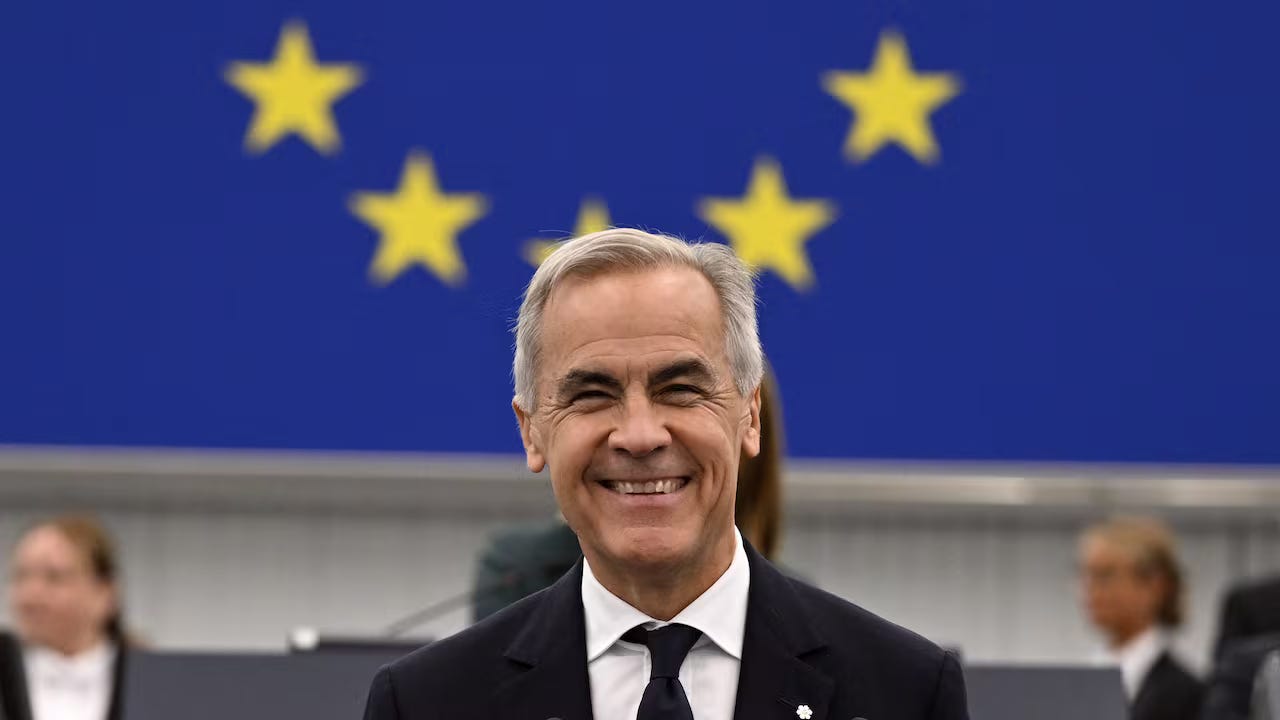
Today offered a rare moment of encouragement for democratic institutions and self‑determination.
Canada’s Mark Carney addressed the European Parliament and welcomed an extraordinary proposal: that Canada might become the European Union’s first associate member. What such membership would mean remains to be negotiated. The category does not presently exist in EU treaties, and Carney emphasized that Canada is not seeking full membership. But perhaps the nomenclature matters less than the idea.
Canada and Europe are considering whether two democratic societies separated by an ocean might voluntarily bind themselves more closely together.
In the world we inhabit, that is striking.
Great powers have always drawn circles around weaker nations and called the result a sphere of influence. Geography becomes entitlement: this country belongs with us; that country falls within our security perimeter; another is too close to a great power to be entirely free to choose its own future.
The European Union offers a different model.
It is, in an important sense, a democracy of democracies. Twenty‑seven sovereign nations — carrying different languages, cultures and occasionally bitter histories — have chosen to entrust common institutions with substantial authority while retaining their own governments, elections and national identities.
It is hardly Shangri‑La.
The EU struggles with immigration, security, environmental policy, economic growth and the complicated business of getting twenty‑seven governments to agree on almost anything. Democracy does not promise efficiency or harmony. It promises the opportunity to choose leaders who improve conditions, safeguard freedom, protect minority rights and preserve peace.
It promises the chance to make wise decisions, not the guarantee of them.
Canada is not being absorbed into Europe. Europe is not claiming Canada. No borders are being moved. No maps are being redrawn. Canada and the EU are discussing whether deeper cooperation on defense, energy, critical minerals, artificial intelligence, trade and other strategic concerns might strengthen both — and help preserve their independence in a world increasingly shaped by great‑power competition. Carney himself emphasized sovereignty and suggested that such cooperation might serve as a model for other democracies.
There will be difficult questions. There should be.
Canada will have to decide how much regulatory or economic integration it wants. European governments will have to decide what they are prepared to offer a country that is not geographically European. Parliaments will debate it. Governments will disagree. Citizens will have opinions. The final arrangement may look very different from what was discussed today.
Nothing is guaranteed.
But perhaps that is what made the moment encouraging.
In an age when powerful nations increasingly speak about others in the language of territory, buffers and spheres of influence, Canada and Europe are discussing something quite different.
Not who belongs to whom.
Who chooses to stand with whom.