

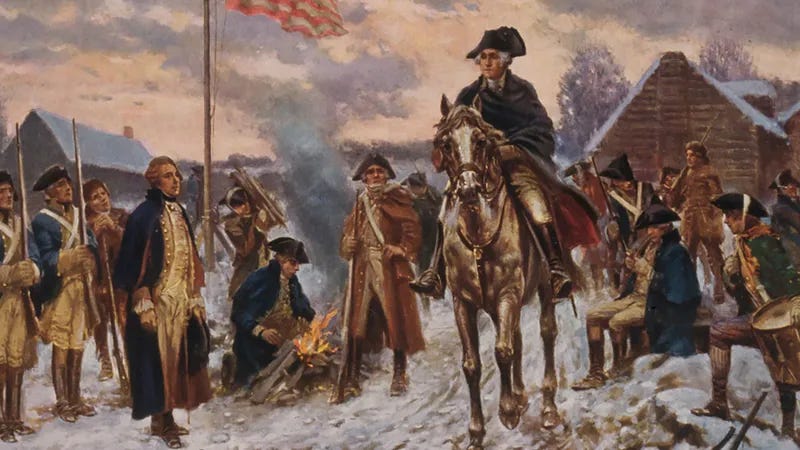
Ken Burns’s The American Revolution is a monumental achievement, and in many ways the perfect companion to his Civil War. We tend to think of the Revolution as the cleaner story—the moral clarity to the Civil War’s moral catastrophe—much as we often regard World War II as simpler than World War I. There is a right side, we tell ourselves. A colonial victory is a victory for democracy, a blow against monarchy and empire.
That neatness is comforting. It may also be misleading.
When rioters stormed the Capitol on January 6, many invoked 1776, not 1861. They did not see themselves as secessionists defending an existing hierarchy, but as revolutionaries reclaiming a republic. That choice of reference is revealing. It points not to preservation, but to rupture—an insistence that the old order has failed and something new must be born.
Yet choosing a side in 1776 was far more morally complicated than our retrospective certainty allows. Britain was not a cartoon tyranny. It had a parliament, a long constitutional tradition, and many colonists had prospered within the imperial system. Taxes were imposed from afar, yes—but was that alone sufficient cause to risk life, property, and social order?
Slavery would survive the Revolution. Women would remain without political rights for generations. The promise of equality was aspirational at best, deferred at worst. For many living at the time, allegiance to the Crown may have seemed the safer, even more responsible choice. Revolution is easy to admire once it succeeds.
So what, precisely, does 1776 signify when it is invoked today?
Is it an acknowledgment that the republic has drifted from its constitutional moorings? A claim that something entirely new must be created? Or simply the belief—sincerely held by some—that an election was stolen and extraordinary action was therefore justified?
That ambiguity matters. The Revolution has long served as America’s moral export: a founding myth about self-government, restraint of power, and civic responsibility. If that myth is now being repurposed to justify grievance, exclusion, or personal loyalty over constitutional order, then we ought to ask—quietly but seriously—what we now stand for.
In 1984, as a newly graduated high school student, many of us believed we had a clearer answer. Perhaps that confidence was earned. Perhaps it was naïve. Perhaps every generation believes it understands the founding better than the founders themselves did.
What history reminds us—if we are willing to listen—is that democracy is never a settled achievement. It is a choice, renewed or abandoned in each era, under different pressures, by imperfect people.
The lesson of 1776 is not that rebellion is always righteous, nor that institutions are always corrupt. It is that moral seriousness requires judgment—hard judgment—about power, legitimacy, and consequence.
And the burden of that judgment did not end with the founding.
It belongs to us still.